More Jupiter and Orion

jupiter2

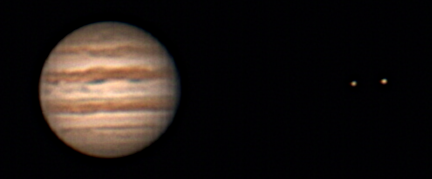
We went out again last week, here is another attempt at Jupiter, it is getting better, although you can see the camera pixels on this one but we have two moons too, definite progress.  By the way, it’s really easy to see Jupiter’s moons and when we took the picture the great red spot was on the other side. We took more than 15,000 exposures thanks to a comment posted on this blog and it worked, thanks for that!

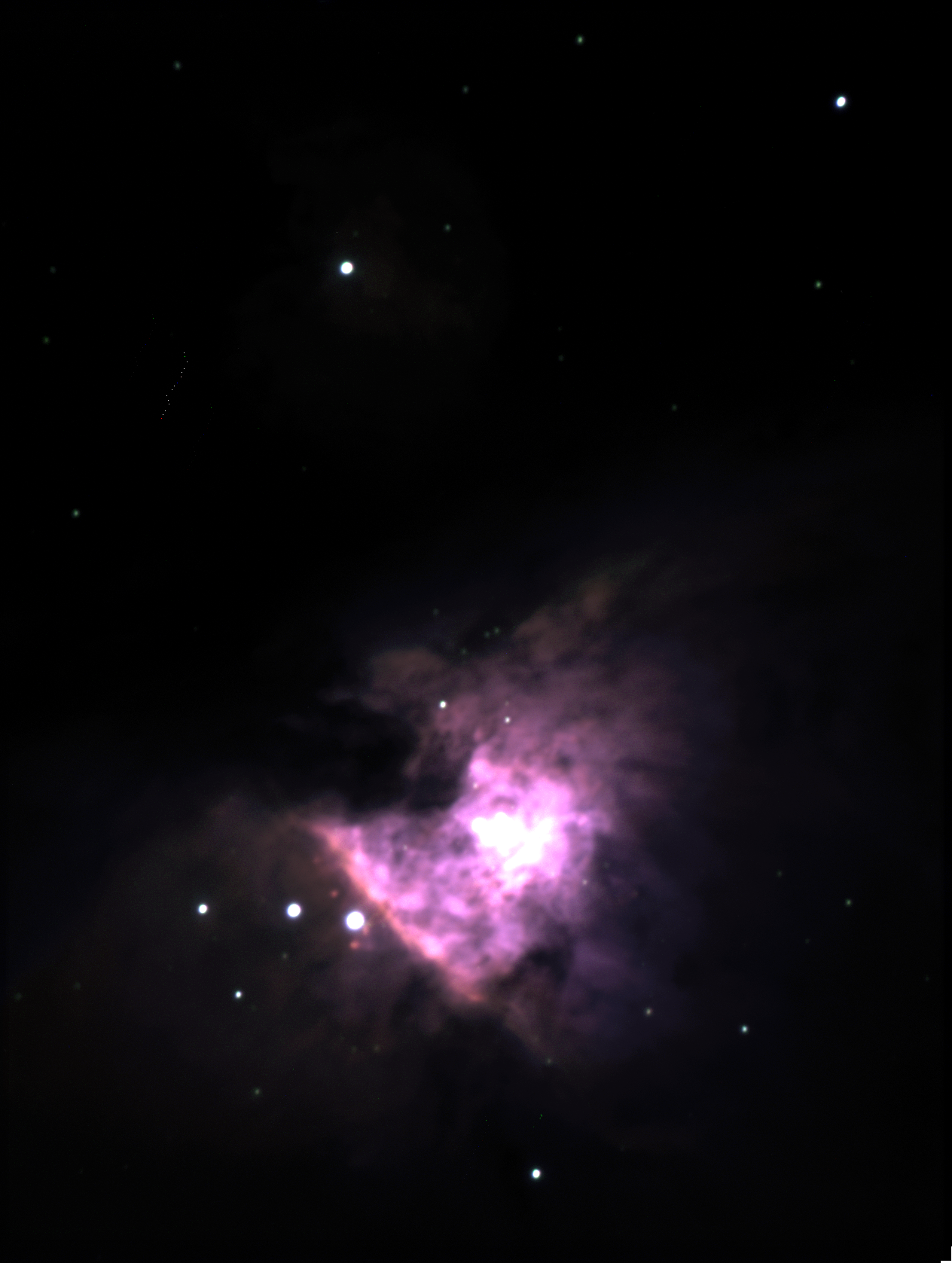
Next I’ll show you the prettiest colour picture I’ve managed to make so far of the Orion Nebula using different filters.  It isn’t great but I’ve spent hours trying to do different things and this is the best I’ve come up with in terms of aesthetics so far.

M42

So thanks to all for following the blog in 2014 and I hope you have a good holiday!

orion nebula first attempt

first evening trying new camera

Orion Nebula M42

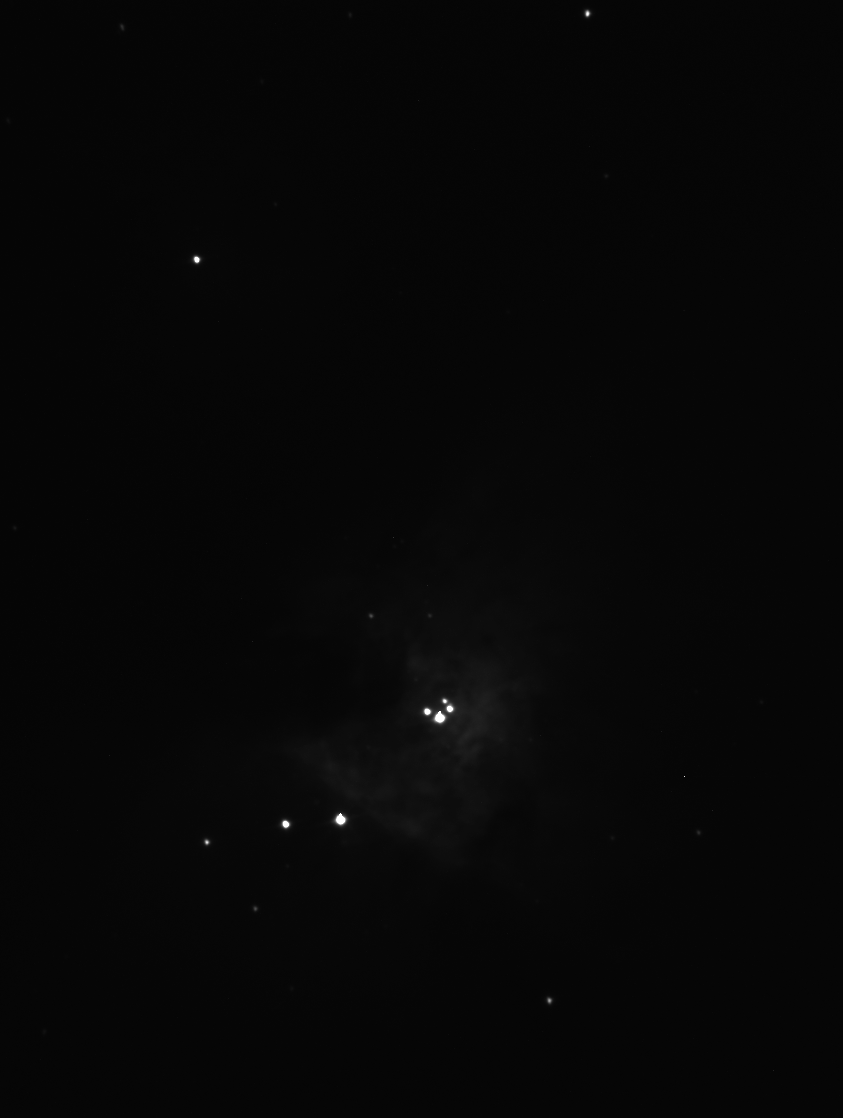
The 42nd object in the catalogue of Messier (M42) is called the Orion Nebula.  We’ve recently taken delivery of our better quality CCD camera, which is an Atik 383L+ and we tried it for the first time tonight.  We (Sunayana and I) got this image of the Orion Nebula, which is not bad for a start.  We also got one with a shorter exposure

1stneb

As you can see it’s sharper.  Perhaps we need to stack images and see if we can get the sharpness with the cloud details as well. But we didn’t get very far.  But the camera works!

We were going to go for something else but we run out of batteries… Our car battery is flat because we’ve been using the dew heater to stop dew from building up.  I guess we’ll try again when the weather is clear again.

First preliminary images – Jupiter and the Moon

First Attempt at imaging Jupiter, this will improve!

First Attempt at imaging Jupiter, this will improve!

We’ve been up on the roof many times since the last update.  Usually it’s pretty frustrating, I’ve become an expert in weather websites.  We still don’t know what we are doing, we don’t have a very good camera yet and we still haven’t got a digital focuser.  While we can see them, we certainly can’t take photos of nebulae, galaxies or anything like that yet.  We also need a reducer (de-magnifier) for that, they are generally much larger than the field of our camera and our current camera is not very sensitive.

So we are left with planets, but the planets are currently not really being helpful.  Mars is only visible shortly after dusk close to the south west horizon – basically you are looking through lots of Lamborghini exhaust from Chelsea.  Me and Edo tried to look at it.  The air was so turbulent it was as if the planet was on fire.

Nick at the Widescreen Centre (who is the best thing about the Widescreen Centre) says we should forget looking at anything less than 25 degrees below the horizon.  Jupiter is only about 30 degrees above the horizon at 1am and I can’t stay up till 4am.  This will get better in the coming weeks and months but for now, there is our first attempt at imaging.  I did it with Sunayana tonight.  She was up for staying later and it would have got better too, as Jupiter is rising, but I wanted to get home.

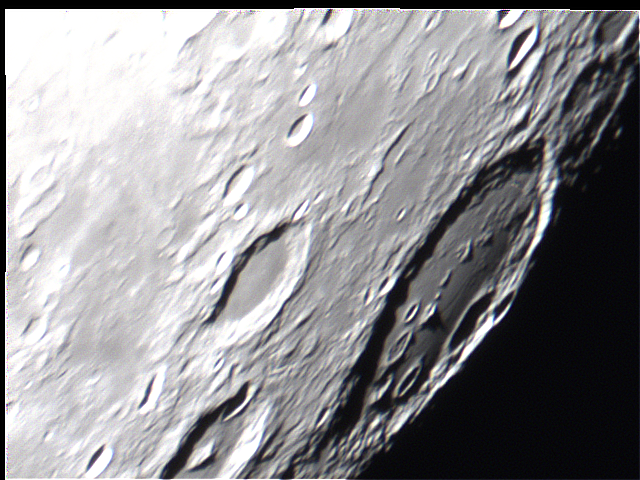
We also looked at the moon and did some picture taking, I think with better seeing we will be able to improve on this a bit, but I do wonder how good the seeing ever gets in central London.  Now we’ve just got a new boiler, I’m hoping for a cold snap!

Part of the Moon

Gauss Crater, actually on North Eastern Limb of Moon

UPDATE:  I found out this is Gauss Crater using my wife’s Rand McNally Moon Atlas.  It’s not South East it’s North East.  Bit difficult to tell which way is up when it’s a full moon…

Computer Control of the Dome

Over the past few posts I’ve been using the expression “We have done XYZ” a lot rather than “I have done XYZ”, which as any PhD supervisor knows probably really means “My student has done XYZ” at least to some degree.  In this case to a very large degree the vast majority of the ongoing work in the dome has been carried out my my second student intern Sunayana Bhargarva, who has been working for twice as long as Edo officially did. Unfortunately we haven’t had too much in the form of pictures or videos of her to put up here (careful readers will have spotted her in some videos).  Mark my words however the greatest effort and momentum over the past two months in this project has come from her.

She has been trying to get the dome to rotate 100% reliably, we are not there yet but we are on the way:-

In the early stages of getting the dome to rotate via the motors, after prolonged use, the cogs would start to disengage with the timing belt, generating horrendous noise and no rotation. This was, in part, due to the cylindrical structure of the motor, causing it to slip on the wooden shelf and no longer maintain the angle needed to grip the belt.
This problem was attacked by Sunayana using some high grade emery paper, slotted under the bottom of the motor and inside the necessary jubilee clips (anyone know why they are called that?), to provide enough friction and control against any unwanted rolling or slipping. Additionally, wedges were placed underneath the wooden hinges supporting the motors to achieve maximum contact between the cogs and the belt. As the motor shelves are tightened in their positions, the contact is most strong along the bottom half of the cog. However, by reinforcing the wooden hinges with wedges, the entire system is pushed up slightly, allowing the top of the cog to also make continuous contact with the timing belt, making rotation smoother and less prone to jarring.

So that’s pretty nasty messy frustrating stuff.  Something more satisfying is what else she has been doing and that is getting the whole dome to rotate from a computer, which has involved a complicated set of relays, but which she has got working now.  I’ll let her explain:-

Now that the computer can move the dome, we hope to get the dome to track the telecsope automatically, but we’ll show you when we get that to work.

You should probably also know that Sunayana is quite an accomplished musician and successful poet, here she is reading one of her poems:-


Edo’s funny video and Bill the technician

So Edo had to make a blog for his summer project and as part of it he did this, which, I admit, is berlusconic genius :-

Apart from that I was pleased to see that he had also got videos of one of the most important people in getting the telescope up and running, that is Bill Luckhurst.  Bill is our research technician, he maintains the sensitive equipment the serious experimentalists in our group use, the only part of it that I really understand is that he maintains the scanning electron microscope which is used by all the nano people so they can figure out what they are doing.  They’re all doing very small stuff, so they all need to use this device quite often.  But I know for a fact he does a lot more than that, because basically people ask him to do whatever stuff they can’t do, LIKE ME.  I always felt a bit conscious of recording him for the blog but luckily Edo didn’t mind, and since this blog is a record of the dome being brought back into use, I’m pleased we have these, you can see them at the bottom of this post.

Meanwhile, we’ve been trying to make the rotation more reliable, it does OK, but it keeps catching at certain points.  We’ve been experimenting with different springs etc etc…  We’ve also made progress getting the dome to track the telescope, but that’s for later.

With regards to observations, we’ve been out, but there are no planets at this time of the year apart from Saturn close to the horizon.  In London we can forget anything close to the horizon, the people at the widescreen centre who supply our gear tell us to forget anything less than 20 degrees, and if you see how Saturn jumps around on our screen when you try to image it in its current position you can’t disagree.  We’ve got the filters up and running but since then we haven’t had any good nights, we’ve had cloudless nights but not without a thin veil of high altitude cloud which means we can’t see any galaxies or nebulae, so no action.  During these failures we are figuring out how to work things a bit better though, so when we do actually have good seeing I hope we will have stuff to share with you.

In the mean time, here are some videos from Edo (i.e. I’m not responsible) of Bill:-

https://www.youtube.com/watch?v=xX9OznuE7d

Getting the Dome to Rotate

Usual apology for not posting things in a frequent or timely fashion. This post will probably be quite boring to anyone thinking “OK, where are the pictures of galaxies?”

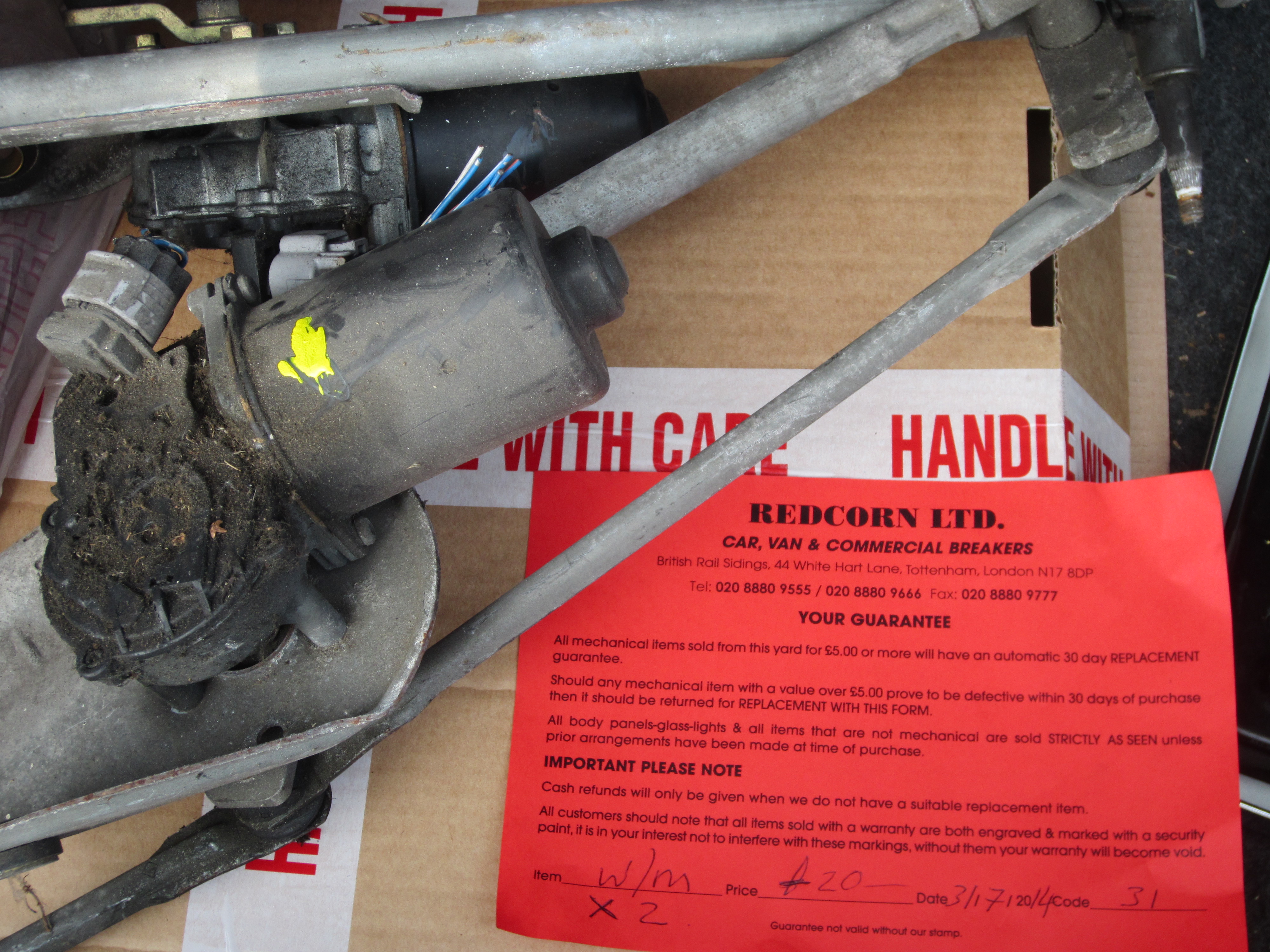
One of the hardest things we have been trying to achieve is getting the dome to rotate electrically.  I read online that you could do it with windscreen wiper motors, so I went to the scrapyard in Tottenham on White Hart Lane.IMG_2833IMG_2831

The gentlemen there can get you loads of stuff and seem completely unphased by my not caring what car it comes from. I’ve been back to visit a second time now as we destroyed the first couple of motors.

IMG_2834

They come with part of the old mechanism attached but Edo got that off and cleaned them up for us.  The idea is to attach a cog on the end and then use it to drive timing belt which we put up all around the interior of the dome.  Timing belt is the belt with teeth on inside a car engine which coordinates the opening and shutting of the valves with the rotation of engine.  They couldn’t sell us this so we had to buy it from a specialist who was able to get us a single 10 metre length which was good as we need more than 9 metres for our 3 metre diameter dome.  We also bought a cog from them.

The rest of what we did is better explained in video form.  So if you are interested, feel free to click but beware, this has been a lot of fiddly frustrating work by Edo, Sunayana and myself over the summer and the length of the video reflects this.

So you see it only goes one way, but we hope to fix that soon.  Please note there are TWO switches.  One is to make it go left and right, it will only go left for now but we will fix that.  The other is currently top secret.  All will be revealed if we ever get phase 2 to work.  Sorry, WHEN we get phase 2 to work…

testing the telescope on a hot day

Hi, so I’m getting a bit behind on these updates.

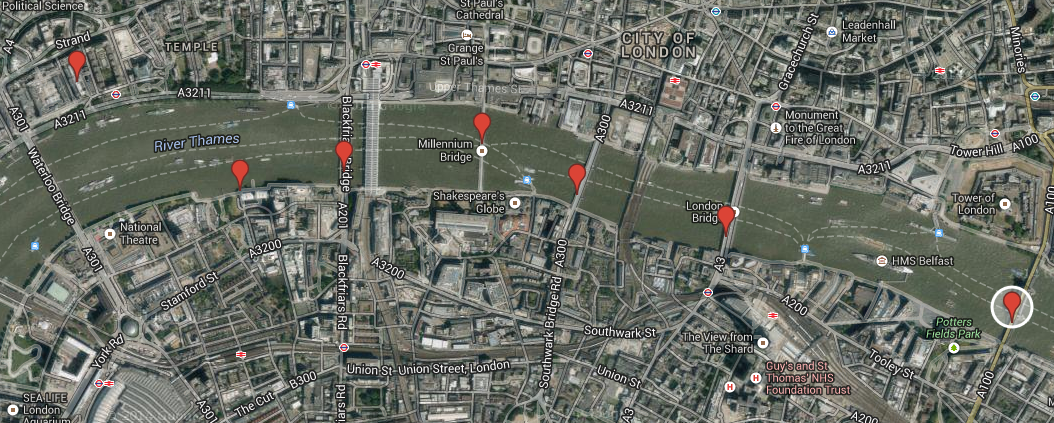
It’s been HOT in london.  We tested the telescope the other day by sending Edo down the Thames and seeing if we could see him at various places, here is the itinerary:-

edorunning

So the red marker on the left is the telescope then we have the OXO building, Blackfriars Bridge, Southwark Bridge, Millenium Bridge, London Bridge then finally Tower Bridge.

I had him hold up a sign at each bridge, the original idea was for him to hold up a sign with the name of each bridge on, but having written the first sign ‘OXO’ we stuck with it because you wouldn’t have been able to read the writing if it was any smaller.

So here he is at OXO building which is 570 metres away

oxo2oxo1

It’s very blurry.  This is due to there being a huge amount of vibration from the building below during the day, and also because there is a significant heat haze, and probably due to the fact that we are looking over the thames, etc etc.  more later.

We then sent him to Blackfriar’s bridge which is 840 metres awayblackfriars2

not very good…  but we (me and Sunayana, the new student helping me) were enjoying making him run around.  So we sent him onwards to Millennium Bridge (the wobbly one to the tate modern distance of 1220 m)…

mil2mil1

Southwark bridge (distance of 1520 m)

southwark1southwark2

London Bridge (the one the bankers go across like zombies) distance 1970m

london

and finally tower bridge, distance 2860 m

tower1tower2

So you can see this isn’t great.  The main problem is the vibration and focusing and heat haze.  Have a look at this video of London Bridge 2 kilometres away :-

You will also be able to see Sunayana in that video.

We have been out at night since then, and we’ve had a bit more luck…. but more about that soon.

Telescope in the Dome

So on Friday we decided to stop messing around and actually get the telescope in the dome. First we had to carry the boxes from my office onto the roof which involved a lot of grunting and sweating and swearing.

Then we attached the “electronics pier” to the central column using the adapter that was built for us by Paul in the engineering workshop.  It doesn’t look like a pier but I’m used to piers that don’t look like piers as I come from Wigan

SONY DSC

Then we lifted the mount onto the “pier”.  It was very very heavy.

SONY DSC

At this stage we were becoming slightly euphoric because we hadn’t broken anything yet and it seemed to be going OK.

SONY DSC

Then we managed to get the telescope on top, which was also very heavy and very scary because you don’t want to drop it.

SONY DSC

And there we are.  We’ve not got it wired up yet but we have established that it works (yes we have looked at the shard and no, we didn’t see anything interesting).  Without the motor wired up it’s almost impossible to look at particular things, we just managed to establish that it actually works and makes things that are far away look big, which it does, which is good.

The very nice and professional people at the KCL PR department are looking for positive stories at the moment so they made a nice video of the process, which you can look at here:-


The (Brout-Englert) Higgs boson and the Stability of the Universe

So last night social media went mad with a story about the higgs boson destroying the universe, which I slowly realised was about my own work which my (very good) student Robert Hogan

1475ec2

had been presenting at the national astronomy meeting in Portsmouth.  I thought given the interest I should write something about it here.

So far at the LHC in Geneva they have discovered the higgs boson and nothing else that they hadn’t already seen.  The higgs boson is the final piece of the jigsaw puzzle we refer to as the standard model of particle physics which contains all the particles that we definitely know exist.  Without the Higgs the theory wouldn’t make sense.

We expect other particles to exist that we haven’t seen before, notably dark matter which we are pretty sure exists and we are looking for in laboratories and in space.

However if you just take the particles that we DO see, there is something s bit funny about the higgs field.  You may have heard that the higgs field is “switched on” throughout the universe.  That means that even in regions of the universe that are completely empty the higgs field has a particular non-zero value, which gives rise to masses for the other particles as they move around.  The value is 246 GeV (where GeV are Giga electron volts – the units of particle physics).   The reason for this is there is a potential energy for the higgs field which has a minimum at 246 GeV.  This is why the top quark, which is the heaviest quark we know, has a mass around 173 GeV which is 246 GeV divided by the square root of 2 and is the heaviest a quark could be that gets its mass from the higgs.

The funny thing I was talking about earlier is that this minimum of the potential is not the only minimum for the higgs field, there is another one at a much higher value due to quantum effects (around a hundred milion GeV depending on the precise value of the masses of the top quark and the higgs boson mass, which tells us how stiff the higgs field is to ripples).  If the higgs field in our universe was to exist in this higher minimum then all the quarks would have very high masses indeed! It would certainly look a lot different to our own universe.

What is more, the energy of the potential in our current 246 GeV minimum is only infinitessimally larger than zero and gives rise to the gentle acceleration of the Universe we refer to as Dark Energy (we have no idea why it is so close to zero). The energy density in this higher minimum would be negative, which would presumably make the Universe quickly collapse.  So on the whole, for a variety of reasons its a good job we are in our 246 GeV minimum and not the higher one!

So that sounds dangerous, but our minimum and the higher one are separated by a big potential barrier which keeps us from falling into the higher, dangerous Hogan_figure_2minimum.  We could quantum tunnel through that barrier, but the time it would take for that to happen is much larger than the age of the Universe, so while it could happen before I reach the end of this sentence, it probably won’t.  (phew, It didn’t)

Separately the BICEP2 experiment has come out and said that it has detected evidence for polarisation of the cosmic microwave background radiation that is compatible with a period of rapid expansion of the very early Universe known as inflation.  Not just any old inflation, but inflation with a high energy density that would make the universe expand EXTREMELY quickly as opposed to just VERY quickly (I lack the adverbs for such rapid expansions).  This rapid inflation would lead to quantum fluctuations in all the fields in the Universe at that time, including the higgs field, and if the expansion was that quick, the higgs field would have been bumped into the higher minimum where the Universe collapses.

It is really important to point out that we are not the first people to think about this, in particular this paper by two very clever Italians and one clever Spanish guy, all of whom I got to know when I worked at CERN, looked at the same thing.  We did a very similar calculation using the latest values from the LHC and from BICEP2.

So why hasn’t our Universe collapsed?  Well this is just telling us that if BICEP2 is correct then there has to be some new physics which will come in and change the quantum theory and get rid of the higher, dangerous minimum in the Higgs potential.  We expect new physics to exist, I mentioned dark matter, but we also need to explain where neutrinos get their masses from and why there is more matter than anti-matter and all these things need new physics that could help decide whether the second minimum exists or not.

Still it would be nice to know that this extra physics has to exist otherwise the Universe will collapse.  It would be a great motivation to keep looking.  The trouble is now people don’t know if the BICEP2 team are actually seeing polarisation signals from the big bang or from some boring dust in the Milky Way and we are all just going to have to wait to find out which.

moving forwards slowly

hatch underneath dome

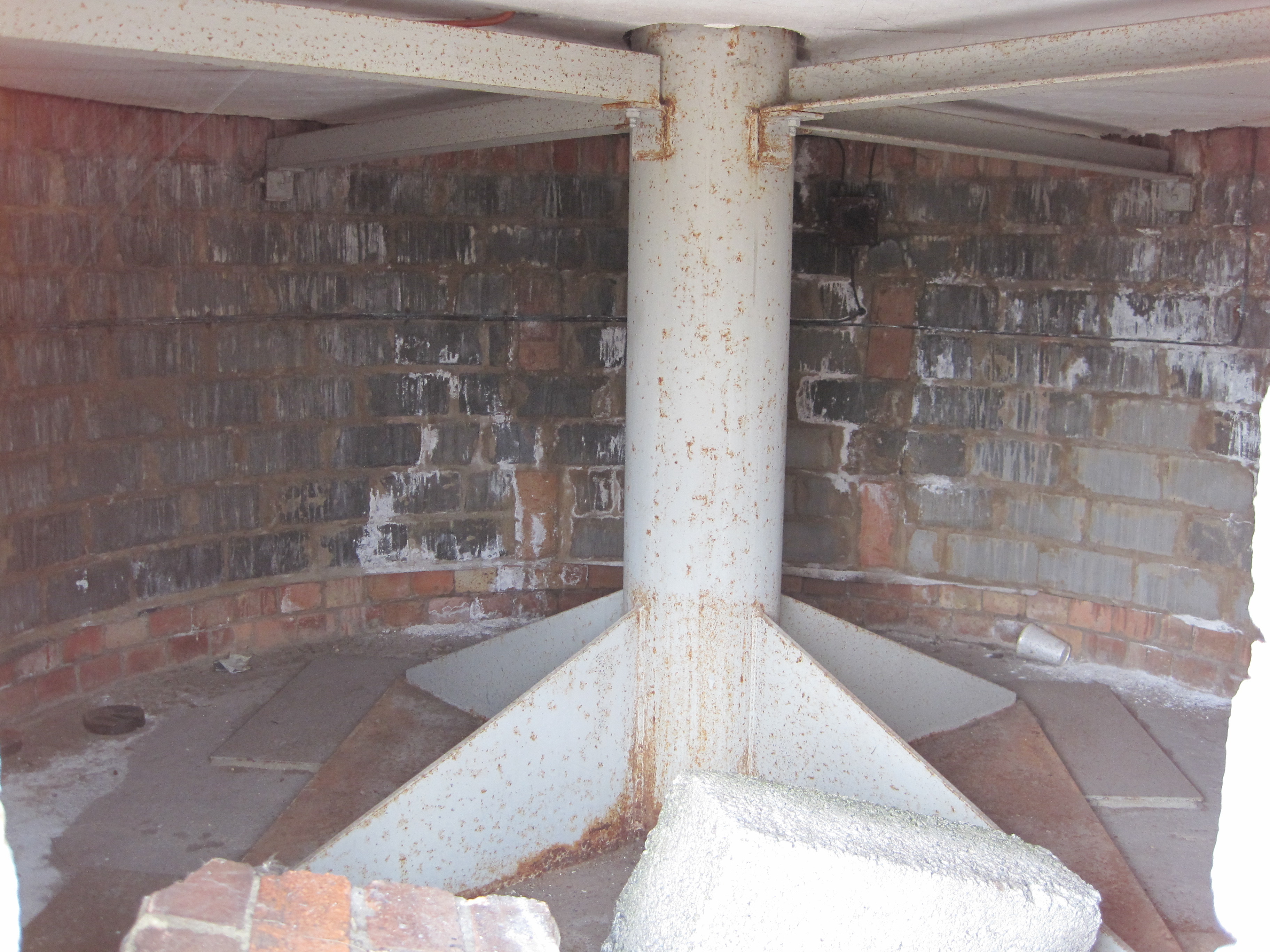
This is the hatch underneath the dome

IMG_0534

and this is what it looks like in there

IMG_0535

Its been leaking under here but we think we know where from and we’ve sealed it up…

IMG_0538

and figured out how everything is wired up

So that finally we were able to make a bit of progress.

We’ve been up to a load of other stuff too, you should see that sooner rather than later, although apparently some folk are making a movie on the roof next week, which may slow us down a little…